Resistance, resilience and functional recovery of a rainforest ecosystem
DFG-funded Research Unit REASSEMBLY (FOR 5207)Posts @bsky@instagram 1st funding phase 2021-2025, 2nd phase 2026-2029
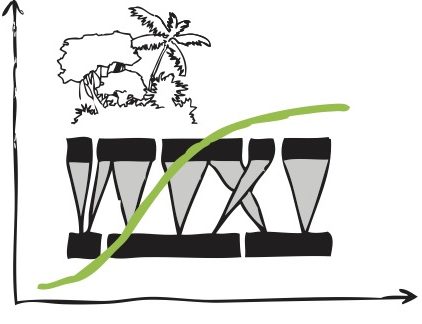
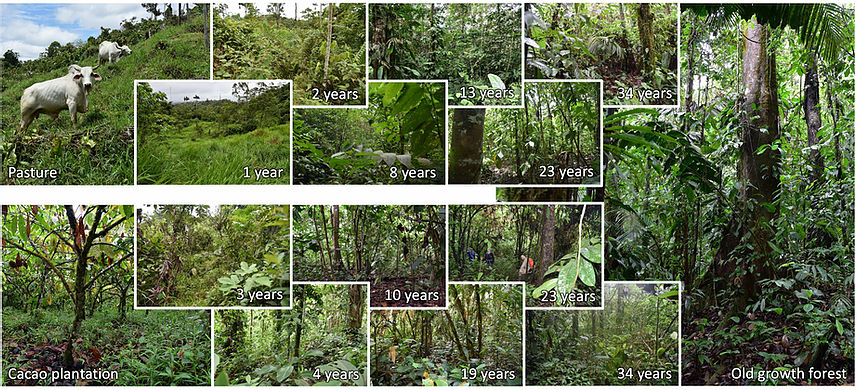
REASSEMBLY aims at understanding network dynamics to uncover rules of network dis- and reassembly in a highly diverse tropical lowland rainforest ecosystem. We study the dynamics of natural forest recovery from agriculture along a chronosequence and the contribution of re-assembled networks to the resilience of ecosystem processes against perturbation. We compare the trajectories of predator–prey, plant–pollinator, and plant–seed disperser networks, as well as decomposition networks between mammals, dung beetles and seeds, and between dead wood, ants, termites, and beetles. Subprojects thus examine networks of all major ecosystem processes mediated by interspecific interactions: predation, pollination, primary and secondary seed dispersal, herbivory, decomposition, and tree seedling recruitment. Networks and ecosystem processes are studied along a large-scale chronosequence of forest recovery (62 plots representing different stages of succession) and in a small-scale perturbation–recruitment experiment. Our Research Unit is funded by the Deutsche Forschungsgemeinschaft (DFG).
Our MISSION: Although REASSEMBLY is a basic scientific research unit, our aim is to ensure that the knowledge gained can be applied and contribute to optimizing the restoration of tropical forests. This research project, funded by the Deutsche Forschungsgemeinschaft (DFG), will not only be conducted within a forest in Ecuador, but on an equal footing with the Ecuadorian scientific community in different institutions and with an Ecuadorian conservation organization (Fundación Jocotoco). Our goal is to strengthen ecological science and the next generation of scientists in both countries, as well as nature conservation efforts that meet the interests of local communities. To achieve these goals, transparent and accessible data and results are essential.
We had a P-REX in our first phase, and now we have the T-REX! For this new experiment, we have planted around 5,000 seedlings, all grown from seeds collected from trees around the area. They are arranged in 4–5 subblocks, each containing 3 seedlings of 16 tree species that grow at different stages of the …
Written by Mark-Oliver Rödel While the Reassembly projects mainly focuses on terrestrial plots from pasture to old growth forests, there is also other important habitats in the areas: streams and the riparian vegetation associated with them. The higher humidity along streams and riparian vegetation may allow forest dependent species to disperse through parts of the …
Fuchs and Rödel report a probable predation event on the Rainbow Galliwasp (Diploglossus monotropis), a rarely seen lizard that lives in leaf litter and under logs. They documented it during fieldwork on frog communities in the Canandé Reserve. On a rainy evening in April 2024, they found a Common Opossum (Didelphis marsupialis) eating a freshly …
Püls et al. studied tiger moth communities (Arctiinae) along the forest recovery gradient, from active pastures and cacao plantations through regenerating forests to old-growth forest, and recorded 3,612 individuals of 210 species using light traps. They found that differences among communities in species composition and functional traits peaked in recovering forests, while old-growth forests hosted …
In Germany we are in a privileged situation regarding research funding – but is this strengh at risk once right-winged nationalist parties gain power? Can goverments change the reasearch agenda funded? Another country – often seen as our role model – currently shows a worrying scenario. Fundamental changes are currently in place for the National …
We use cookies on our website to give you the most relevant experience by remembering your preferences and repeat visits. By clicking “Accept”, you consent to the use of ALL the cookies.
This website uses cookies to improve your experience while you navigate through the website. Out of these, the cookies that are categorized as necessary are stored on your browser as they are essential for the working of basic functionalities of the website. We also use third-party cookies that help us analyze and understand how you use this website. These cookies will be stored in your browser only with your consent. You also have the option to opt-out of these cookies. But opting out of some of these cookies may affect your browsing experience.
Necessary cookies are absolutely essential for the website to function properly. These cookies ensure basic functionalities and security features of the website, anonymously.
Cookie
Duration
Description
cookielawinfo-checbox-analytics
11 months
This cookie is set by GDPR Cookie Consent plugin. The cookie is used to store the user consent for the cookies in the category "Analytics".
cookielawinfo-checbox-functional
11 months
The cookie is set by GDPR cookie consent to record the user consent for the cookies in the category "Functional".
cookielawinfo-checbox-others
11 months
This cookie is set by GDPR Cookie Consent plugin. The cookie is used to store the user consent for the cookies in the category "Other.
cookielawinfo-checkbox-necessary
11 months
This cookie is set by GDPR Cookie Consent plugin. The cookies is used to store the user consent for the cookies in the category "Necessary".
cookielawinfo-checkbox-performance
11 months
This cookie is set by GDPR Cookie Consent plugin. The cookie is used to store the user consent for the cookies in the category "Performance".
viewed_cookie_policy
11 months
The cookie is set by the GDPR Cookie Consent plugin and is used to store whether or not user has consented to the use of cookies. It does not store any personal data.
Functional cookies help to perform certain functionalities like sharing the content of the website on social media platforms, collect feedbacks, and other third-party features.
Performance cookies are used to understand and analyze the key performance indexes of the website which helps in delivering a better user experience for the visitors.
Analytical cookies are used to understand how visitors interact with the website. These cookies help provide information on metrics the number of visitors, bounce rate, traffic source, etc.
Advertisement cookies are used to provide visitors with relevant ads and marketing campaigns. These cookies track visitors across websites and collect information to provide customized ads.